
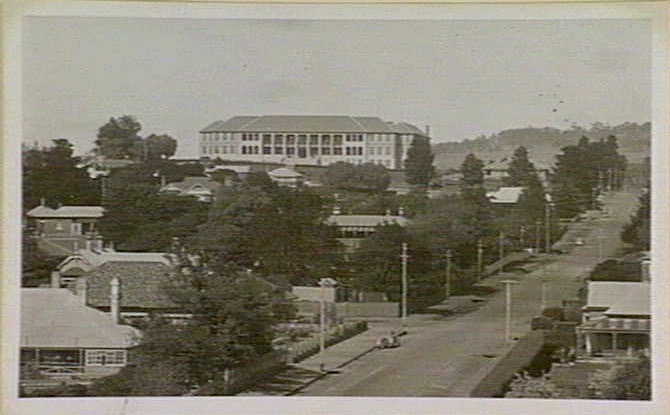
Margaret Mackie: Teacher Extraordinaire
Yesterday was International Women’s Day. I was asked to commemorate a woman who had had a huge impact on me and my career. Although there were other women over the years, the one that stood out for me was Margaret Mackie, a teacher at Armidale Teachers’ College, who was the first to have an impact on me. I was an inhibited adolescent country girl. Before that time, I’d always looked up to males for role models, my two older brothers, one of them an intellectual who had influenced me greatly on my chosen path toward self development.
I chose Philosophy for my first elective subject at Armidale Teachers College where I was preparing to teach primary school subjects in 1961-62. Disappointed that I’d not been accepted into a university, I felt a failure and my self-esteem was in tatters.
Yet ATC is where I find one of those rare inspirational teachers you meet only once in a lifetime. Miss Mackie’s alabaster skin looks like it has never seen the light of day. She sits with her thick stockings, feet held primly together and speaks quietly with a straight back and unblinking eyes, like Pythia, the prophesying sibyl from ancient Greece. She corrects me when I speak with Americanisms, such as “real scary” in my country twang. She is the wise antidote to my mother’s raw, yet sometimes astute utterings.
She tells us stories about Socrates’ courage when he took poison rather than compromise his beliefs and we read from ancient texts. This sets in motion a love of learning about both magic and logic, which speak to me down through the ages and holds me captive in a silver web of paradox, mystery and of learning. After three years teaching, I follow in Brother Bill’s footsteps to Europe, and I will explore the ancient sites brought to life in my teacher’s class.
In Philosophy tutorial, Miss Mackie enthralls us with stories of the Delphic Oracle and the prophecies that occur in the sanctuary of Apollo near Mount Parnassus in Central Greece. Here the Pythia, a priestess of Apollo, gives prophecies while seated on a special tripod positioned over a crack in the earth, from which trance-inducing fumes are said to issue. I feel that I am being seen and heard for the first time by a wise searcher after the truth. Under her tutelage, I understand the ancient texts taken from Socrates’ thoughts and Plato’s writings, including from the four books of ‘The Republic’ about politics and justice.
We discuss The Cold War and the threat from the atomic bomb. I gain a perspective on such issues, and it teaches me to argue logically. I find that I have a natural affinity with Socratic syllogisms and complex philosophical logic, even though I’ve always felt useless at mathematics. It’s the way she teaches us.
I only found out more about this woman after-the-event. From an Article in The SMH: January 13, 2010 — 12:00am
Teacher inspired generations
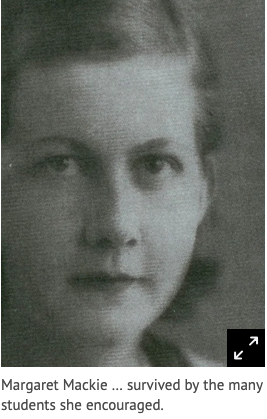
Margaret Mackie, 1914-2009.
Education ruled the life of Margaret Mackie. From her childhood in a house of teaching to her university days and on to her years at the University of New England, Mackie lived, worked and thought of teaching and how best to encourage young minds.
Margaret Davidson Mackie was born in Neutral Bay on November 12, 1914, the elder of two children of Alexander Mackie, a Scot who had come to Australia to be first principal of the Sydney Teachers College and was also Professor of Education at the University of Sydney, and his wife, Annie Duncan, a teacher. She grew up in Wahroonga and started teaching early, making sure her younger brother, John, could read, write, count and tell the time. John became a teacher and a philosopher.
At five, Margaret started at Sunday School, where the first thing she did was to point out that man was descended ”from monkeys” but despite this she was allowed to stay on. In 1924, after some years of lessons from her mother, she went to Abbotsleigh Church of England School for Girls and, in 1933, the University of Sydney.
Mackie graduated from the university with a BA in 1936, with distinctions in philosophy, English and economic history, passes in French and economics, and a credit in botany. She then went on to Oxford, where her father had promised to send her in lieu of a dowry, and took an MA in ”Modern Greats” (philosophy, politics and economics).




Leave A Comment