
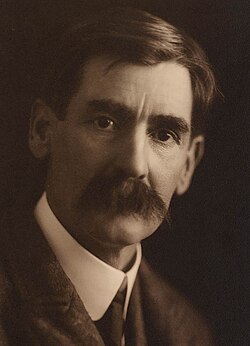
Henry Lawson 1867–1922) was an Australian writer and bush poet. Along with his contemporary, Banjo Paterson, Lawson is among the best-known Australian poets and fiction writers of the colonial period and is often called Australia’s “greatest short story writer. He was the son of Louisa Lawson, a writer and feminist. Lawson regularly contributed to The Bulletin and many of his works helped popularise the Australian vernacular in fiction. Henry Lawson displayed through his poetry an opposing viewpoint about bush living to that of Banjo Paterson. While Paterson’s views were more romantic and idealised, Lawson’s perspective was realistic with a pessimistic edge. The poet effectively criticises “City Bushmen” like Banjo, who made the outback seem like a fun challenge rather than an often gruelling way of life. (Wikipedia)
Freedom on the Wallaby Track
Australia’s a big country,
An’ Freedom’s humping bluey,
And Freedom’s on the wallaby;
Oh don’t you hear ’er cooey?
She’s just begun to boomerang.
She’ll knock the tyrants silly,
She’s going to light another fire
And boil another billy.
Our fathers toiled for bitter bread
While loafers thrived beside ’em,
But food to eat and clothes to wear,
Their native land denied ’em.
An’ so they left that native land,
In spite of their devotion,
An’ so they come, or if they stole,
Were sent across the ocean.
Then Freedom couldn’t stand the glare
Of Royalty’s regalia.
She left the loafers where they were
An’ come out to Australia.
But now across the mighty main
The chains have come ter bind her,
She little thought to see again
The wrongs she left behind her.
Our parents toiled to make a home,
Hard grubbin’ ’twas and clearin’,
They wasn’t crowded much with lords
When they was pioneerin’.
But now that we have made the land
A garden full of promise.
Old Greed must crook ’is dirty hand
An’ come ter take it from us.
So we must fly a rebel flag,
As others did before us,
And we must sing a rebel song
And join in rebel chorus.
We’ll make the tyrants feel the sting
O’ those that they would throttle;
They needn’t say the fault is ours,
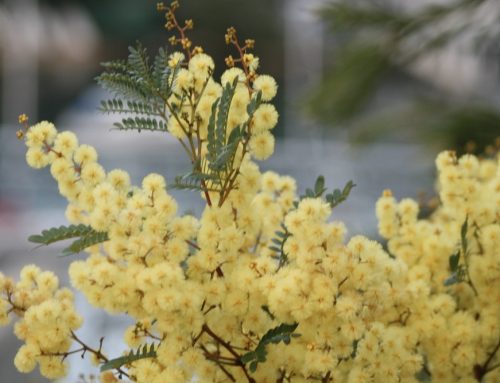
If blood should stain the wattle.
Henry Lawson. Brisbane, May, 1891.
Up The Country
I am back from up the country, very sorry that I went,
Seeking for the Southern poets’ land whereon to pitch my tent;
I have lost a lot of idols, which were broken on the track,
Burnt a lot of fancy verses, and I’m glad that I am back.
Further out may be the pleasant scenes of which our poets boast,
But I think the country’s rather more inviting round the coast.
Anyway, I’ll stay at present at a boarding-house in town,
Drinking beer and lemon-squashes, taking baths and cooling down.
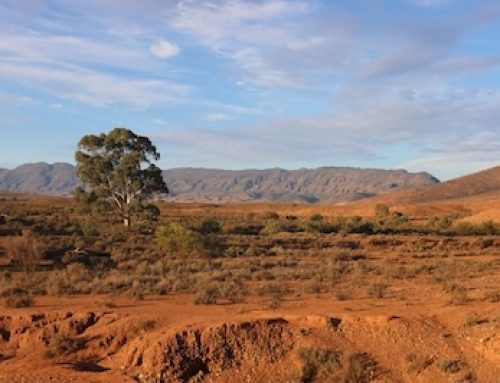
`Sunny plains’! Great Scott!, those burning wastes of barren soil and sand
With their everlasting fences stretching out across the land!
Desolation where the crow is! Desert where the eagle flies,
Paddocks where the luny bullock starts and stares with reddened eyes;
Where, in clouds of dust enveloped, roasted bullock-drivers creep
Slowly past the sun-dried shepherd dragged behind his crawling sheep.
Stunted peak of granite gleaming, glaring like a molten mass
Turned from some infernal furnace on a plain devoid of grass.
Miles and miles of thirsty gutters, strings of muddy water-holes
In the place of `shining rivers’, `walled by cliffs and forest boles.’
Barren ridges, gullies, ridges! where the ever-madd’ning flies,
Fiercer than the plagues of Egypt, swarm about your blighted eyes!
Bush! where there is no horizon! where the buried bushman sees
Nothing, Nothing! but the sameness of the ragged, stunted trees!
Lonely hut where drought’s eternal, suffocating atmosphere
Where the God-forgotten hatter dreams of city life and beer.
Treacherous tracks that trap the stranger, endless roads that gleam and glare,
Dark and evil-looking gullies, hiding secrets here and there!
Dull dumb flats and stony rises, where the toiling bullocks bake,
And the sinister `gohanna’, and the lizard, and the snake.
Land of day and night, no morning freshness, and no afternoon,
When the great white sun in rising bringeth summer heat in June.
Dismal country for the exile, when the shades begin to fall
From the sad heart-breaking sunset, to the new-chum worst of all.
Dreary land in rainy weather, with the endless clouds that drift
O’er the bushman like a blanket that the Lord will never lift,
Dismal land when it is raining, growl of floods, and, oh! the woosh
Of the rain and wind together on the dark bed of the bush,
Ghastly fires in lonely humpies where the granite rocks are piled
In the rain-swept wildernesses that are wildest of the wild.
Land where gaunt and haggard women live alone and work like men,
Till their husbands, gone a-droving, will return to them again:
Homes of men! if home had ever such a God-forgotten place,
Where the wild selector’s children fly before a stranger’s face.
Home of tragedy applauded by the dingoes’ dismal yell,
Heaven of the shanty-keeper, fitting fiend for such a hell,
And the wallaroos and wombats, and, of course, the curlew’s call,
And the lone sundowner tramping ever onward through it all!
I am back from up the country, up the country where I went
Seeking for the Southern poets’ land whereon to pitch my tent;
I have shattered many idols out along the dusty track,
Burnt a lot of fancy verses, and I’m glad that I am back.
I believe the Southern poets’ dream will not be realised
Till the plains are irrigated and the land is humanised.
I intend to stay at present, as I said before, in town
Drinking beer and lemon-squashes, taking baths and cooling down.
Henry Lawson

Leave A Comment